
discover Springbank
Springbank was established in 1885. Early settlers were drawn to the area’s fertile land and stunning natural landscape. Today, Springbank offers residents a peaceful semi-rural lifestyle close to the city, blending open spaces, scenic views and a strong sense of community.
❊ Our History
Springbank Cemetery
The Springbank Churches contain the final resting place of many of its pioneers. In 1974, the South Church cemetery, located by the Springbank Community High School, was closed to further burials and is now recognized as a historic site with appropriate signage.
Springbank Schoolhouse
Springbank’s founding families were instrumental in building a log schoolhouse in 1887, originally located on Lower Springbank Road. This first building was later destroyed by fire. A new one-room schoolhouse was subsequently constructed near what is now the Heritage Club site, and a second classroom was later added as the community grew. The building was eventually moved to a location near Springbank Middle School, where a third addition was completed in the late 1960s. In later years, the building became home to Springbank Cottage Child Care. After many decades of service, Rocky View School Division determined the structure had reached the end of its life, and it was demolished in the summer of 2025.
Springbank Community Hall
Built in 1905, the Springbank Community Hall served as a central gathering place for residents for over a century. The building featured a stage, kitchen, washrooms, and gymnasium space hosting club meetings, birthday parties, wedding celebrations, lively dances and traditional turkey suppers that brought the community together. The Springbank Lions Club operated the hall until the aging structure was deemed condemned, and demolished in 2018.
Its loss left the growing community of Springbank without a central facility where local clubs, user groups, and residents could gather and host community activities. Plans are now underway to address this need with a new Community Event Centre proposed for a site north of Springbank Park For All Seasons.
old banff coach road
This road (Alberta Highway 563) was the original route connecting Calgary with Banff. Construction began in 1907 and it was completed 1909. Initially built for horse drawn carriages (coaches) and early automobiles, the road crossed rugged terrain where travellers often had to ford streams and clear fallen trees from their path.
As automobile traffic grew, the road was paved in the 1930s to accommodate increasing traffic. It became one of Alberta’s premiere scenic tourist routes. Its importance declined with the construction of the Trans Canada Highway in 1941. Today portions of the original route still exist, preserving a link to the province’s pioneering spirit and a reminder of early transportation.
Springbank United Church
Built in 1889, the church was originally named Springbank Union Church. The sanctuary was renovated in 1894 and again in 1994 to accommodate the growing population. Located beside the church is a small historic rural cemetery, cared for by local families and church members. Many of Springbank’s founding families are laid to rest here, serving as a lasting reminder of their legacy and their role in the community’s past and present.
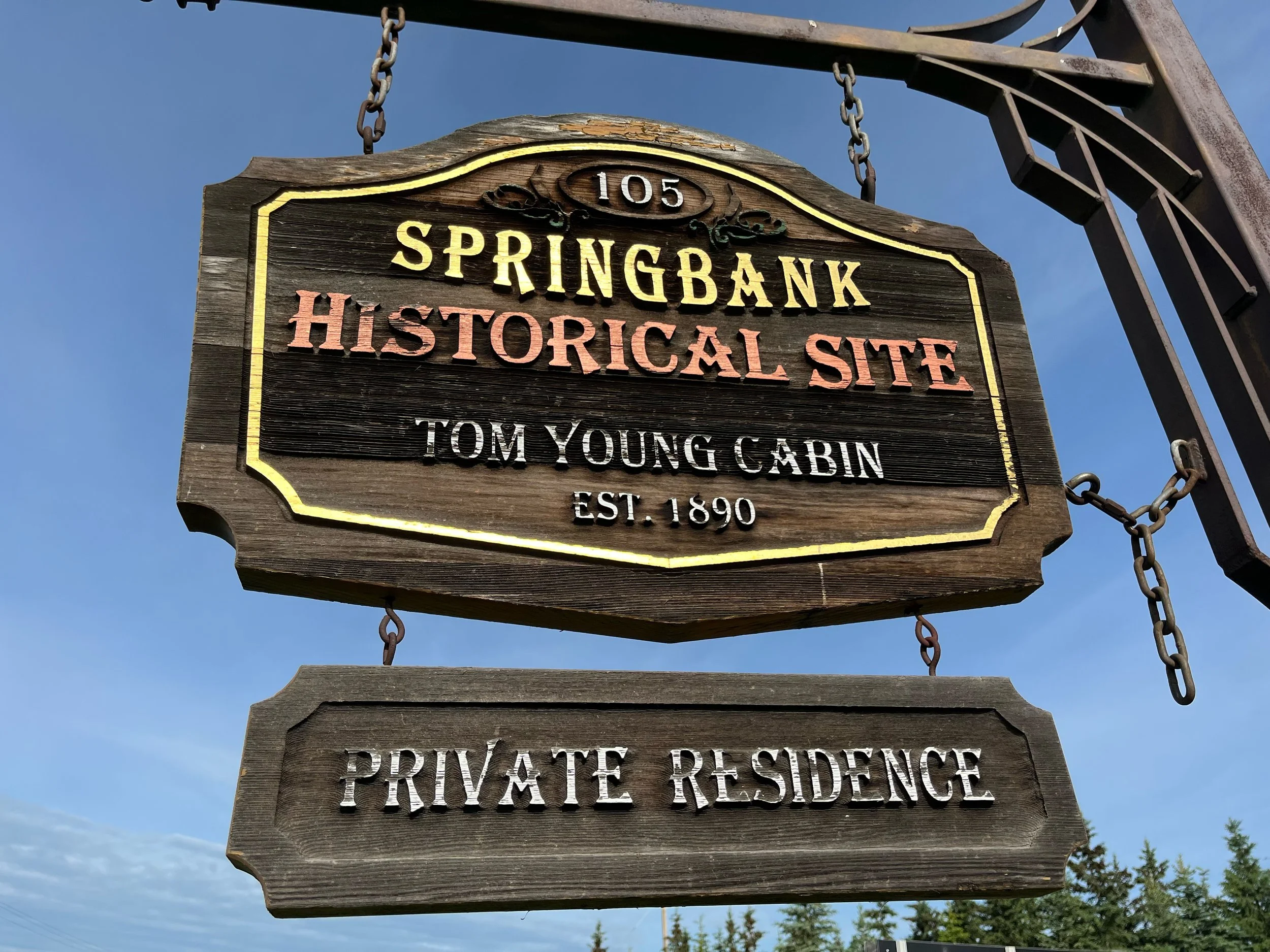
Tom Young’s Cabin
The Young family, one of Springbank’s founding families, built a log cabin in 1885. The cabin still stands today and is located directly east of Springbank Park For All Seasons, serving as a reminder of the area’s early pioneer life.
A History West of Calgary
The two volumes of “Chaps and Chinooks, A History West of Calgary”, documents the history, people and community of Springbank. This area has a rich history rooted in agriculture, dairy and ranching that goes back hundreds of years. Springbank is named after Springbank Creek that flows southeast into the Elbow River and because of its numerous springs arising out of the lesser coulees throughout the district. Over time, it has evolved into a desirable area consisting mostly of country residential acreages. Springbank has played a prominent role in Calgary’s growth, with many eastern portions becoming annexed and developed into the Calgary neighbourhoods.